
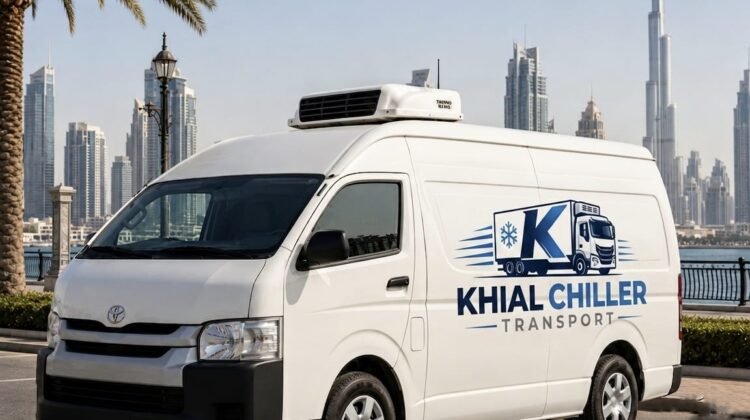
Chiller Van or Chiller Truck?
Chiller Van or Chiller Truck? Where the Cut-Off Actually Falls
Most guidance says vans are for small loads and trucks are for big ones. That is true and almost useless. The decision is usually made by four other factors.
Loading methodSite accessPallet handlingRoute shape
Businesses upgrading from a chiller van to a chiller truck usually do it because the load grew. That is the least interesting reason and often the wrong one. The genuinely decisive questions are how cargo gets on and off the vehicle, where the vehicle can physically go, whether you are handling pallets, and what shape your route is. Get those right and the tonnage answers itself.
01 The First Question Is How Cargo Gets On and Off
Before volume, before tonnage, before anything else: how does the cargo physically move between the ground and the load space, at both ends of the journey?
Van Low floor, hand loading
A van’s load floor sits low enough for a person to lift crates in and out, or to run a trolley up a short ramp. That makes it workable at sites with no dock, no forklift and no dedicated loading team — which describes most restaurants, pharmacies, florists, clinics and small retail units.
Truck High bed, mechanical handling
A truck bed sits at roughly dock height. That is ideal when both ends have docks or forklifts and terrible when neither does. Without a dock or a tail lift, a truck turns a fifteen-minute delivery into a manual handling problem — or an impossible one.
The Practical Test
Walk both ends of your route. If either the collection point or any delivery point lacks a dock, a forklift or a tail lift, you are looking at a van — or at a tail lift truck specifically, which exists precisely to solve this problem. A standard truck bed at a site with no lifting equipment is the single most common cause of a delivery day going wrong.
Site Access Overrides Everything Else
A vehicle that cannot reach the delivery point has no useful capacity, however large the box.
- Height barriers. Basement loading bays across Downtown Dubai, DIFC, Business Bay and many mixed-use towers admit a van and reject a truck at the barrier. This is not negotiable on the day.
- Turning radius and street width. Older commercial districts — parts of Deira, Bur Dubai, and the denser Sharjah industrial streets — are hard work for a rigid truck and straightforward for a van.
- Heavy vehicle restrictions. Some areas and some time windows restrict heavier vehicle movement, which can rule out a truck for a mid-morning delivery that a van completes without issue.
- Parking and standing. A van can often stop legally and briefly where a truck cannot, which matters enormously on a multi-drop urban route.
- Compound and gate access. Some free zone and industrial compounds have gate procedures for heavy vehicles that add real time to every visit.
If your route is predominantly urban, multi-stop and into commercial premises rather than warehouses, access considerations will usually push you toward vans even when the total daily volume suggests a truck.
If You Are Handling Pallets, You Are Handling a Truck
Palletised cargo is the clearest single indicator that the answer is a truck. Pallets need floor area, they need to be moved mechanically, and they need a vehicle whose floor can take the point loading of a pallet truck.
The efficiency gain is substantial. A palletised delivery into a warehouse with a dock can be turned around in a fraction of the time a hand-unloaded equivalent takes, and turnaround time is what determines how many stops fit into a day.
The reverse also holds
If your cargo is loose crates, insulated carriers, boxed goods or anything else that moves by hand, palletisation is not helping you and truck bed height is actively hurting you. Loading crates one at a time into a chest-height truck bed is slower and harder than loading them into a van, and it is more likely to result in a load stacked badly, blocking airflow and creating a thermal problem.
Route Shape: Two Vans Often Beat One Truck
This is the calculation most businesses never run, and it changes the answer surprisingly often.
| Route profile | Better answer | Why |
|---|---|---|
| One collection, one delivery, high volume | Truck | Volume without door-time penalty. Nothing about the route argues for agility. |
| One collection, 3–5 warehouse deliveries with docks | Truck | Pallet handling and dock turnaround dominate; door openings are few and controlled. |
| One collection, 10+ urban deliveries | Two vans, parallel routes | Halves the sequential chain, cuts cumulative door exposure per vehicle, protects the last drop and finishes the day earlier. |
| Long inter-emirate leg then local distribution | Truck for the trunk, van for the spur | The line haul wants volume; the last leg wants access. Splitting the job is usually cheaper than compromising on one vehicle. |
Why two vans is so often the right answer
- Sequential routes accumulate risk — the last stop absorbs every delay and every door opening that came before it.
- Parallel routes finish earlier, which matters when delivery windows are fixed.
- Vans can access sites a truck cannot, so route design is less constrained.
- A breakdown takes out half your day rather than all of it.
The Cost Comparison Is Not What It Looks Like
A chiller truck costs more per day than a chiller van. That comparison is only meaningful if both can complete the same work in the same time, and frequently they cannot.
The honest comparison is cost per delivery completed within the required window. A truck that handles the volume but takes ninety minutes longer per stop because of manual unloading, or that cannot enter three of your delivery sites, is not cheaper than two vans that finish on time. Equally, two vans running half-empty on a warehouse-to-warehouse pallet route are an expensive way to avoid a truck.
The other factor to price in is driver licensing. Heavier vehicles require a heavier licence class, which narrows the pool of available drivers and affects both cost and short-notice availability — a consideration that matters whether you choose self drive or with driver arrangements.
06 Six Questions That Settle It
- Does every site have a dock, forklift or tail lift?If no — van, or a tail lift truck specifically.
- Is the cargo palletised?If yes — truck. If it moves by hand — van.
- Are any delivery points in basement bays or restricted-access districts?If yes — van, regardless of volume.
- How many stops per route?Above roughly eight urban stops, consider two vans in parallel rather than one larger vehicle.
- Is the constraint weight or volume?Dense cargo hitting payload limits argues for a truck; light bulky cargo often just needs a high-roof van.
- Is there a long trunk leg?Inter-emirate line haul plus local distribution is usually two vehicles doing what each does well, not one doing both badly.
If your answers point in different directions, that is genuinely useful information — it usually means the job should be split rather than compromised. Send the stop list to dispatch and we will model it both ways.